
MACHAIRA: The Carnage of Troy | Artworks, Artists, Markets

MACHAIRA: The Carnage of Troy
Artworks, Artists, Markets
The Masterpieces
The three Attic masterpieces in connection each other along this itinerary are firstly some amazing examples of vase painting, as well as extraordinary tales by pictures. They are fruits of the creative genius and of the technical skill of some potters and Greek decorators, experimenting on perfect and elegant shapes, the new red-figures technique. The vases were made in Athens, the capital of ceramic among all the other Greek cities, at that time, between the end of 6th and the beginning of 5th century B.C., a critical time for Greece, culminated in the famous Persian wars. Thanks to the signatures or thanks to art history attribution methods, we know the artists names: Euphronios, Euxitheos, Onesimos, Kleophrades. The krater is signed by Euxitheos as potter and Euphronios as painter, while the kylix is signed by him just as potter. It was probably painted by his pupil Onesimos, a real specialist in decoration of two handles cups. Stylistically, the hydria has been attributed to the painter of Kleophrades. Actually, behind these names there were a lively reality made of artisan workshops, in competition each other, both for local and the foreigner market. The pioneer Euthymides, for examples, teacher of Kleophrades the painter, wrote on a vase exported to Vulci: “Like Euphronios never did”, to mean that he was the best and that he was professionally envied by the other colleagues. Then, the authors of our vases were the most renowned of the late-archaic age and their artifacts were appreciated also abroad. The major part of the most refined Euphronios’ works of art was found in Cerveteri, a sign that this Etruscan city was a privileged market for such decorated vases. Using the words of Robert Cook, we could say that these vases had the label “For foreign countries only”.
The Artists
Regarding the development of visual arts and in particular of the drawing, Euphronios and Painter of Kleophrades stand as giants, in the evolution of Greek art. We could actually consider these artists, and some of their contemporary colleagues, such as an experimental avant-garde. The Sarpedon krater, in particular, is a revolutionary work of art, both technically and stylistically, especially in the way that movement is represented within the space. The direction of the blood’s gushes, over the giant’s dead body, for example, shows that the corpse was turned anticlockwise, before being lifted.
Since then, there had never been such naturalism in the vase painting. In this artifact, the virtuosity of the foreshortenings and the anatomical rendering of figures reaches their highest point. Same taste and attention to the body will be reached during the Renaissance only. Concerning the Painter of Kleophrades, a painter younger then Euphronios, he can be considered one of the most talented Master of the so called severe-age, or in that phase of Greek art which paved the way to classicism. The feature of this painter is a solemn monumentality, megethos, a characteristic previously owned by Lydos and Ezechias. Both painters Kleophrades and Euphronios and his collaborators created vases technically perfect, with harmonious shapes, confirming that the role of potters in the process chain was essential. Accurate was also the secondary decoration, in this case consisting in some friezes and little palms.
The Inscriptions
An added value in the vases made by Euphronios and by his collaborators were undoubtably the painted inscriptions identifying the characters, and of course the signatures of the artists. On one hand it used to be a way to make the scenes more understandable, on the other hand, it was a professional pride showing off for potters or painters.
There are no clearest evidence of the social level and of the type of awareness reached by these artists. The kylix of Onesimos and Euphronios has also a peculiar element: over the Greek writings, painted beside the characters of the tales by pictures, under the foot of the vase (restored in ancient time!), there is a very precious Etruscan inscription, the name Herakles. Living proof that after being used for a while, this vase came to Etruria and it was consecrated in the Herakles’ sanctuary, in Caere.
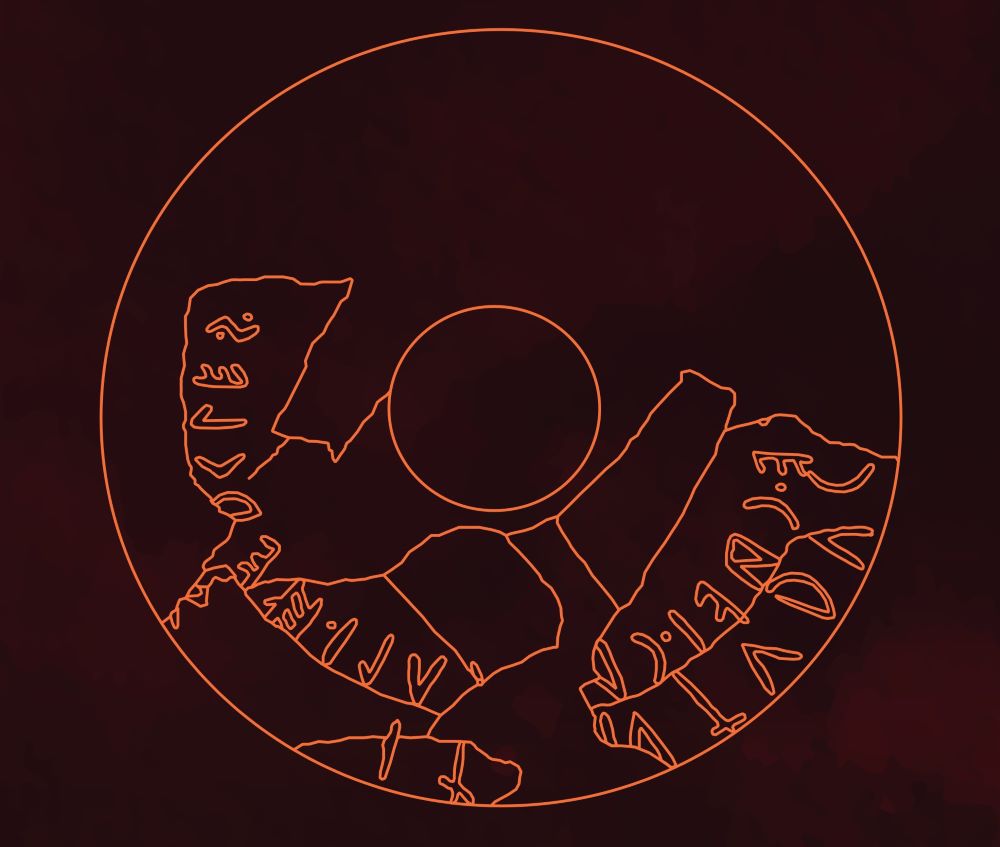
Drawing of the inscription engraved under the foot of the kylix of Euphoronios painted by Onesimos